Are There Rules in Art?
How useful are rules in
art? If it were a science, there would be fixed laws, as in physics and
mathematics. If not, is it possible to set rules? Leonardo da Vinci says yes: “Truly
this is science, the legitimate daughter of nature, because painting is born of
(that) nature. “ And Leonardo gives us a lot of instructions and advice.
But before we take them literally, we should consider what the meanings
of the words art and science were at the time of Renaissance. The definition of
art may have included any skill; those of science any kind of generalized
knowledge. Leonardo speaks mainly of the physical and physiological aspects of
painting, of perspective, color, light and shade, of anatomy and botanic, of
proportions and movement, rather than of esthetic theory he talks of art as
imitating nature Yet Leonardo, obviously, does not merely imitate nature.
Neither should we. The concept of Nature, and of art as its imitation, was a
novelty in his time. There was no concept of the freedom of the artist and of
the diverse paths art can take.
Science, as we define it
now, gives unique but provisional answers to problems. Unique because a
physical phenomenon has, in principle, only one correct explanation;
Provisional, because in physics, chemistry or biology new theories are
continuously formed that replace previous ones. Art, instead of a single
explanation, offers a selection of solutions for an esthetic problem. There is
not one way only of doing things. Tradition and invention alter our ways of
painting, but no one is forced to accept any precept or to join any movement.
Suggestions can be given, but no absolute rules or canons. Art is, ultimately,
a testimony to man’s freedom. Yet, there exists a common ground for the
appreciation of art, beyond time and space. We are able to enjoy the beauty of
the cave paintings of Lascaux and
Color:
Light is the part of electromagnetic radiation that is visible to our
eyes. It covers a range of wavelengths,
from violet to red, orange, yellow, green and blue. Black and white are not
real colors in the physical sense. Black is the absence of light, and white a
mixture of colored lights. Colors that when added produce white (e.g., green
and red, yellow and violet, blue and orange) are called complementary.
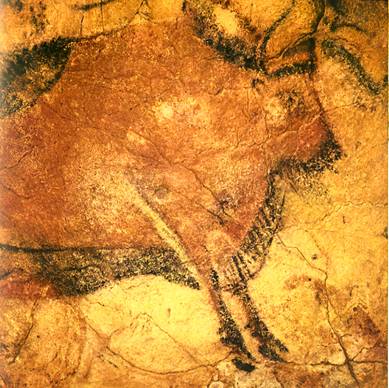
Fig.1. Altamira cave painting.
The characteristics of a color are hue, saturation and brightness.
Light can come from objects that emit it, such as flames, the filaments
of electric lamps, fluorescent bulbs, the stars or the sun, and from objects
that receive light from another source and reflect it (including the sky and the moon). The colors
of pigments result mainly from the absorption of certain components of the
white light and reflection of the colors that were not absorbed.
Fig. 2 illustrates the effect of mixing colored lights (not pigments!).
On the edge of the figure are the spectral colors from red to violet. A line
between any two points on the edge shows the colors observed when mixing the
pure colors. The lines between complementary colors pass through the white
center. Given the shape of the color field, we can inscribe a triangle
red-green-blue (Fig.3) that covers most (but not all) of the possible hues and
saturations. The end points of this triangle indicate what we call the primary
colors. By adding these three we can obtain practically all colors of the
spectrum. We can verify this by looking with a magnifying glass at a TV screen
in action. The graph represents hue (along the borders of the figure) and
saturation (diminishing towards the figure center). To also include brightness,
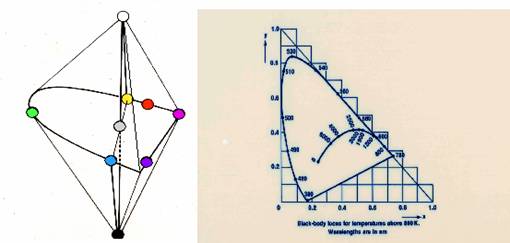
we have to create a three-dimensional figure, with an axis from white through
gray to black (Fig. 4)

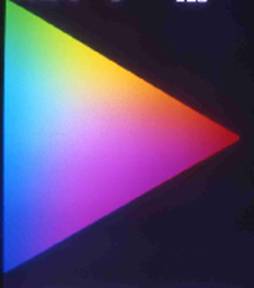
Fig. 2 Fig.
3
. Fig. 4 Fig.
5
Given the continuity of the color spectrum, the choice of primaries is
somewhat arbitrary. From the point of view of color perception, there are four
basic colors, red, yellow, green and blue. Black and white are usually added,
and other colors (e.g. orange, brown, purple) are mixtures of these six.
The curve inside the diagram of Fig. 5 shows the location of the colors
of hot objects, starting with red and moving towards white with increasing
temperature. For this reason we call them warm, and this analogy is very good.
A painting, with its border and frame, is like a room; although parts of it may
hotter or colder, it has usually a predominant temperature, related to the
color of the illumination (and the mood of the painter). See figs. 6 and 7.
.

Fig. 6 (Degas)
The landscape by Degas (Fig. 6) is limited in the range of hues and
brightness; yet is has beautiful colors and a warm atmosphere. The Cézanne
landscape (Fig. 7) in turn, is painted
in cool tones.
The perceived hue, saturation and brightness of a color are affected by
adjacent colors. If surrounded by dark it appears to be brighter, if by warm
colors, cooler, etc. Rudolf Arnheim (Art and Visual Perception, U. of Cal.
Press, 1974, p.369) believes that the pure colors are neither warm or cold, but
that warm or cold colors result from adding other colors to the primaries: red
plus a bit of yellow is warm, with a bit of blue it is cool. One could also
argue that the concept of warm/cold is due to deviations from an expected local
color, which can be attributed to the source of light.
(Or the painter’s mood).
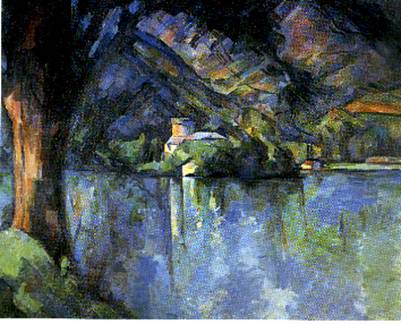
Fig. 7 (Cézanne)
Pigments.
The pigments we use in painting absorb a wavelength range of the light
that enters them, and reemit the remainder. Let us assume that a certain
pigment receives white light that contains the full color spectrum, and that it
absorbs light in the color range marked with the white arc on Fig. 8. The color
of the light it emits then changes as indicated by the arrow. A pigment
absorbing blue light will therefore emit the complementary color, which is
orange. The exact effects of mixing pigments must be determined by
experimentation, but the color of the resulting mixture is that which results
from the absorptions by its components. The ‘primaries’ for the palette of
pigments are therefore the complementaries of red, blue and green, that is,
cyan (blue-green), yellow and magenta
(Fig. 9, right). These are the ones used in color printing.
As we mix pigments, the saturation diminishes, and so does the
brightness. A mixture of the three primaries gives black. If we wish to
increase the brightness of a mixture, we must add white pigment (or, in
transparent watercolor, let the white paper shine through). The colors of
pigments are not fully saturated and our palette would be incomplete if we were
to use three primaries and white only.
But black can be approximated quite well by mixing pigments (for
instance, alizarin red, cadmium yellow and ultramarine blue). Such mixtures,
which still may conserve some tinge other than pure black, are often preferable
to the pure black that comes in the tubes.
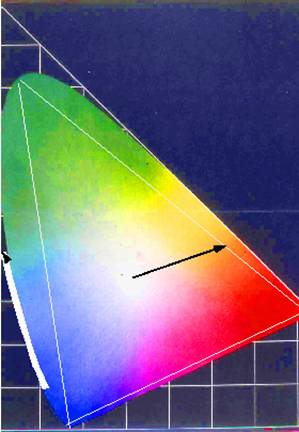
Fig. 8
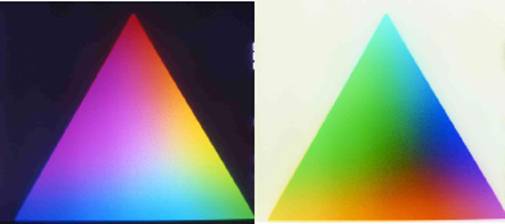
Fig. 9
Since simplification is part of the artistic process, we usually chose a
relatively small range from the thousands of colors that are available. Our
first instinct is to apply to depicted objects their object, or local, colors.
But the perceived colors depend also on the illuminating light. (Fig.10).
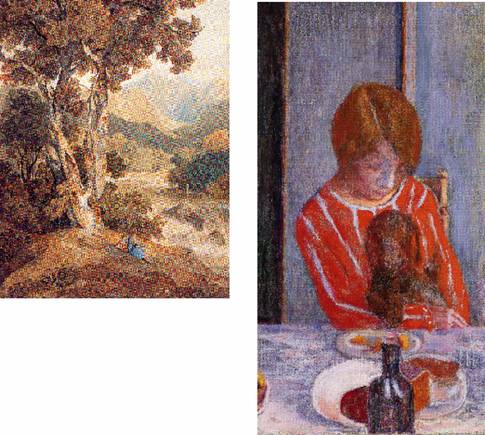
Fig. 10 Fig.
11. (Bonnard)
Features that contrast in
color or in brightness with their surroundings attract our attention.
Complementary colors are often used, such as the orange of the tower, figure 7.
Two colors only are often sufficient for the desired effect (Bonnard,
Fig. 11. Usually one color is dominant
due to its area, central position, or saturation. When the contrast in the
picture is mainly one of brightness, a very narrow range of colors can be used
successfully, (Fig.12). On the other extreme, strong color contrasts can be
used when the colors are applied flat (Fig. 13). To emphasize emotional
aspects, we can freely change colors as well as shapes. From the expressionists
onward, colors have been chosen frequently for emotional value (Fig. 14).
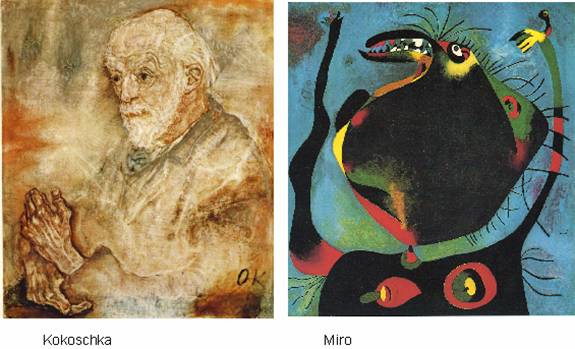
Fig. 12 Fig.
13
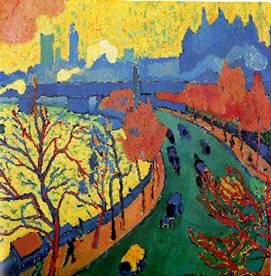 Fig.
14. (Derain)
Fig.
14. (Derain)
The contrasts of hue and
saturation may vary greatly from one picture to another, but all paintings show
contrast of light and dark; even the pure saturated colors cover a range of
brightness, from yellow to deep blue and violet, as can be seen on a grayscale
reproduction of the color
triangle (Fig. 15).
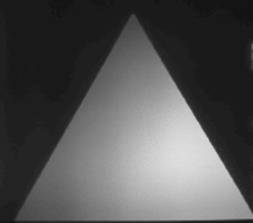 Fig. 15
Drawing:
We must be able to draw correctly the contours or anything we paint. Drawing
is important even if we do not intend photographic accuracy: we must be able to
put on paper or canvas whatever we intend to be there.
 Fig. 16 (K.H.)
Try omitting the unnecessary, simplifying, repeating effects,
restricting colors, and/or limiting contrast. Make a portrait or figure with a
minimum of brushstrokes, ( Fig.16)
Geometrical Perspective.
Geometrical perspective
creates a realistic three-dimensional view on a two-dimensional plane. It is
said to have been invented at the time of renaissance. However, perspective was
discovered rather than invented, since perspective is due to the fact that the
apparent size of objects diminishes with their distance from the observer.
Horizontal parallel lines such as
borders of a road or the top and bottom of a wall converge at a point at the
horizon. All objects situated above the level of our eyes are seen above the
horizon, and those below it are below the horizon. (fig. 17)
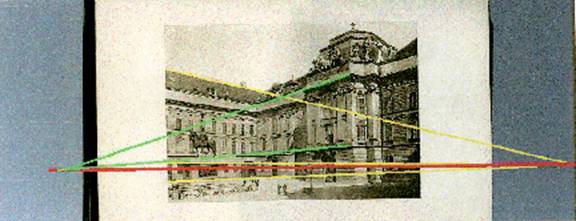
Fig. 17
The green and yellow lines connect at the horizon, (red) which marks the
eye level of the observer.
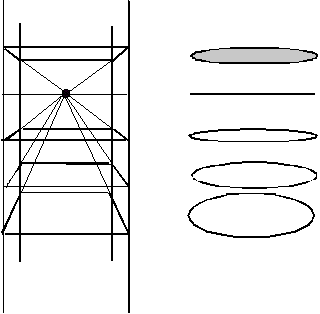
Fig. 18 illustrates the effects of perspective on a set of shelves, and
one of horizontal circles, at various heights. The uppermost shelve and circle
are seen from below. The black circle indicates the height of the
Horizon.
Ever since Cézanne,
painters have ignored or stretched the rules of perspective, stressing the
flatness of the canvas, and so can we (Fig. 19). Still, when we paint a
landscape, we include or imply a horizon. Where should we put it? Of the three
seascapes (after Canaletto) on fig. 20, the middle one is the least
interesting. It is not usually best not to divide a picture by the middle into
sets of equal size. (See, however, Fig, 7!)
. 
Fig, 18
 Fig 19. (K.H.)
The golden rule is often cited as a prescription for harmonious size
relations in a picture. If a length is to be divided into two segments, or a
rectangle is defined by the length of its height and width, the ratio of the
larger segment or side to the smaller one should be equal to the ratio of the
sum of both to the larger fragment or side. This ratio turns out to be about
equal to 1.6. Measurements of the height
and width of common commercial canvases show that they have ratios close to this
number. In fig. 20, the ratios of the total height to the mayor field are 1.4
for the upper and lower picture, and 2.0 for the middle, which is less
satisfactory. In fig. 21, the ratio of height to width is also 1.4. While we
should not worry too much about these numbers, it is advisable that lines and
areas should not be divided into two equal parts.
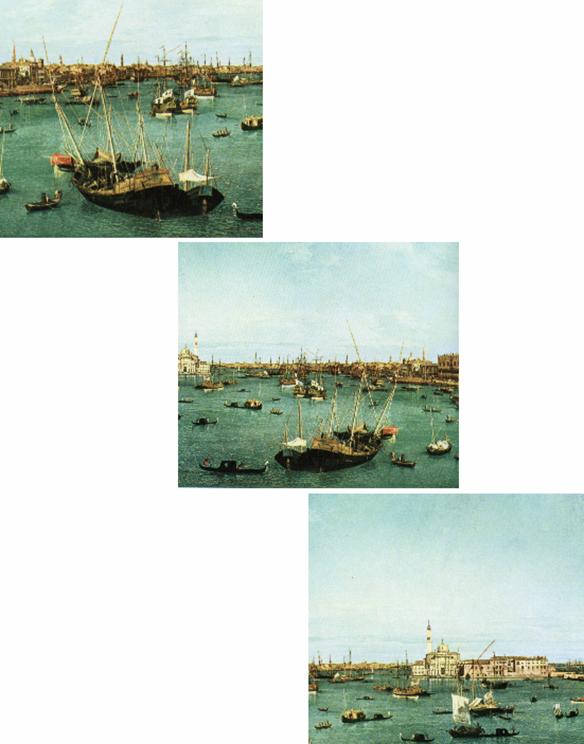
Fig 20 (fragments from a painting of Canaletto).

Fig. 21 (Leonardo da Vinci)
This beautiful portrait by Leonardo da Vinci of Emilia Gallerani,
mistress of Lodovico Sforza, is painted with a limited set of colors. The
contours are simplified to elegant arcs, and a drop shape is used repeatedly in
the construction of the painting. (Fig. 22). The black hair band on the
forehead is seen as a straight line; it is at the eye level of the painter. The
ermine has symbolic connotations, which, however, seem to be controversial.
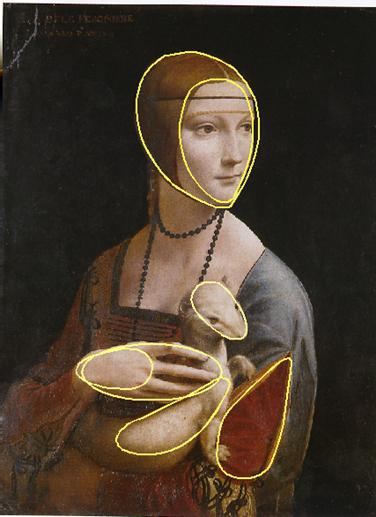
Fig. 22
Aerial Perspective:
Painting is presenting a three-dimensional space on a two-dimensional
surface. In realistic painting, one creates the impression of depth, both by
the design (geometrical perspective) and by the choice of colors.
Due to the greater absorption of warm colors in the air, distant parts
of a landscape appear cooler than the foreground; they show less contrast and
less saturation. The green leaves of the tree in the foreground of
fig. 10 are painted a yellowish brown, in order to keep the foreground
warm. Against the warm brown of the soil, the leaves still are cooler. The
green color was treated in landscape painting with great caution.
Aerial perspective does not apply to portrait or still-life painting,
since the absorption of warm light takes place over large distances only.
However, even in these genres, objects closer to the painter (e.g. hands or
feet) are often painted larger than natural. ( Fig. 23). This not only gives an
impression of close distance, but it has also emotional implications.
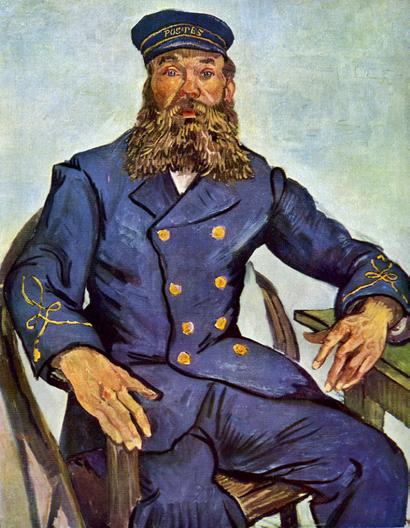 Fig.23. (Van Gogh)
Unity:
If the artwork were
merely an imitation of nature, the best painters would all paint alike, and we
could not recognize at a glance the paintings of our favorite. But a painting
is not merely a report on nature. It is a representation of a perceived or
invented order. (Cézanne said that he was seeking to paint something ‘parallel
to nature’, and Klee: ‘ I do not paint the visible; I paint the invisible’.
Zola referred to painting as ‘ nature seen through a temperament’.). The
painting, surrounded by a conspicuous frame, is analogous to the scenario on
which a drama is presented. And like a scene at the theatre, it must exhibit a
logical and artistic coherence. This need for order distinguishes it from a
casually chosen slice of our surroundings.
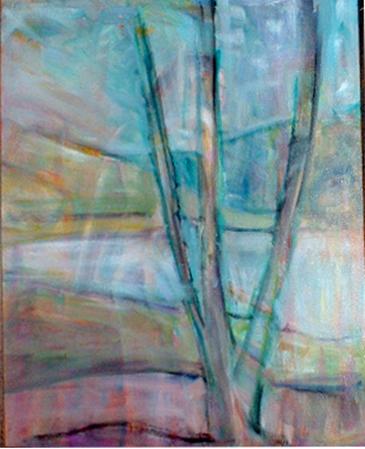
Fig. 24 (KH). This landscape
consists exclusively of wedges of similar shape.
.What lends coherence and order to a painting? Besides the
considerations of color we have discussed, the following elements help to unify
a painting: the kind of brushstrokes, the repetition of shapes of lines and
forms (figs20-22, 25), a wekk-defined direction of illumination (fig. 21), and
a harmonious arrangement of the components (good composition).

Fig. 25 (Li K’é-jan)
A discernible direction
of the illumination was introduced (reinvented?) in the Renaissance, and again
neglected after the arrival of impressionism.
Composition:
How are the parts of a painting organized? Practically all paintings
have areas (not necessarily objects) that, for their brightness, shape or
color, attract our attention (figs. 26, 27). Like the parts of a mobile, these
areas must be carefully balanced. But a moving object such as a horse or a bird
is not in equilibrium: it moves into the space before him, and leaves the past
behind (fig. 24), even before it has taken to flight (fig. 29)
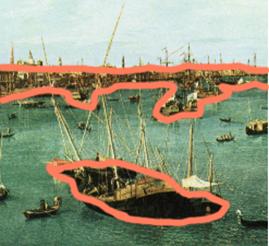

Fig, 26. The prominent features of figs. 20 and 21
In the classical portrait, the person to be depicted was placed in the
center of the picture. In a more expressive mode, she may also claim the space
in front of her, into which she looks, and may perhaps move later (fig. 30). The figure, as a rule, looks into
the center. In the painting of a group, (fig. 31) most persons do so as well.
But if a person is offset and looks in the outward direction, a strong
imbalance and tension arise. In fig.32, the model, which happened to be blind,
is seated facing the wall, close to the picture corner. This strong centrifugal
element is opposed by the figure at the right side of a painter in front of her
easel. Although small, this figure contrasts strongly with her surroundings, is
located right at the border, and looks downward, not at the model. Therefore
she balances to some degree the model. The picture, in the absence of people in
its center, gives a strong feeling of incommunicability between people.
Fig. 32 illustrates how the model, and all the other objects, assume
their autonomous function as part of the pictorial surface. While the naive
observer gives his attention to the objects only, from the compositional point
of view, the spaces between objects, called negative spaces, become equally
important (Fig. 33) and must be carefully designed. With increasing
abstraction, the difference between positive and negative space vanishes.
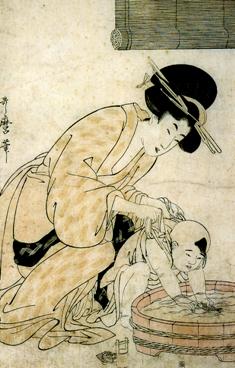
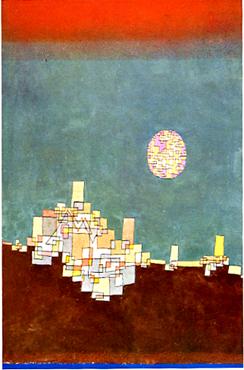
Kitagawa Klee
Fig. 27. The black (left) and light (right) areas are carefully
balanced.
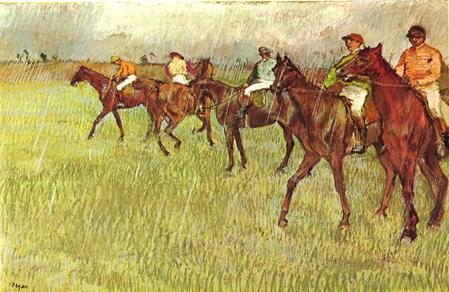
Fig. 28 (Degas)
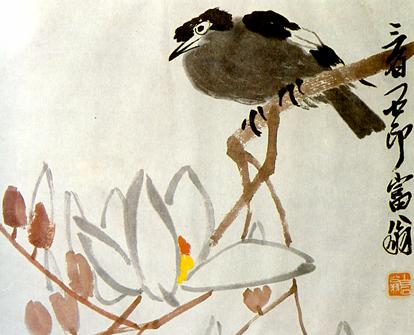
Fig. 29 (Chi Pai-shih)

Fig. 30 (Gauguin)
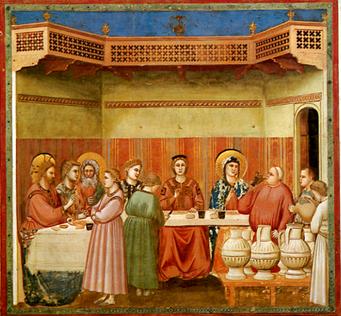 Fig. 31 (Giotto)
 Fig. 32 (KH)
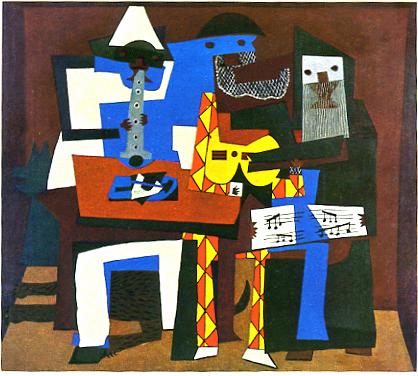
Fig. 33. (Picasso) shows the importance of negative space.
How many focal points?
While the eye covers a
wide angle, sharp vision and attention are limited to a narrow field; I cannot
read a column of newspaper without moving my eyes sidewise. Therefore, when we
look at a painting, the eye cruises over its surface, and our brain integrates
the information into a complete picture. The idea of the contents in an
enclosure is the same as that of the Chinese ideogram (fig. 33), in which the
message is esthetically arranged and surrounded by a rectangular enclosure. Our
cruise within the picture would be interrupted if our eye were guided outwards
beyond its edges. We should arrange the picture elements so as to return our
eye to the center.
It is often assumed that every
picture has one center point towards which our eye is attracted. This is often
the case (figs. 6,7) If it were too forcefully so, the travel of our eye, and
our interest, could end right there.

Fig. 33
(Chinese Ideograms)
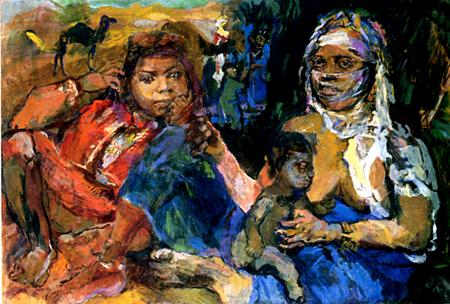
Fig. 34 (Kokoschka)
I find it difficult, however, to decide where this center is located, in
figs.30, 32 and 34. There are often two or more focal points between which my
eye moves forth and back (fig. 34). Such an ambiguity is not unexpected in art,
which thrives on the ambiguous. The presence of two persons, or other features
of attraction, of almost equal weight, is quite common and usually more
interesting than a picture with one focal point.

Fig. 35
Where is the focal point?
Abstraction.
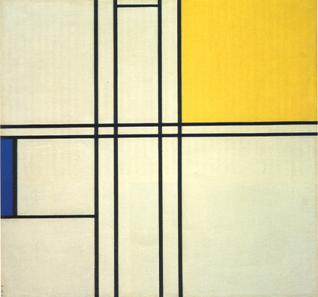
A radical change in painting occurred in the second part of the 19th
century, in reaction to the stale academism of the time. The trend was first
toward a more realistic depiction of every day life and of society, but
gradually the painting became more abstract, a trend that terminated in a
non-representative style (figs. 29-31).
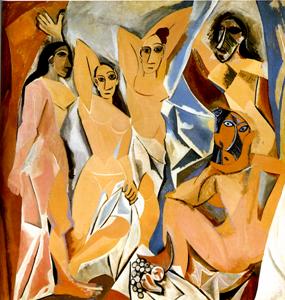
Fig. 36 (Picasso)
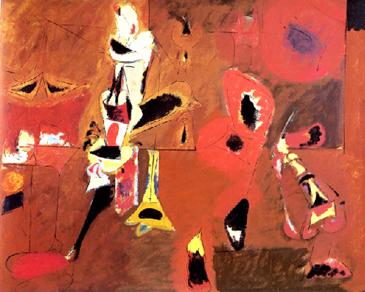
Fig. 37 (
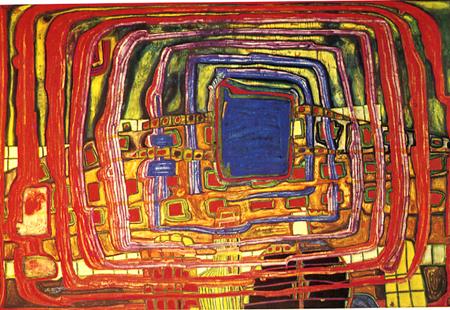
Fig. 38 (Hundertwasser)
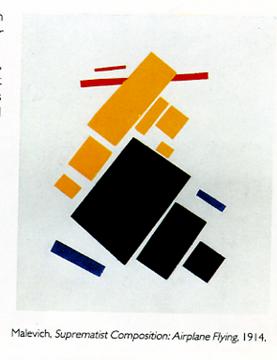
Figl 39 (Malevich)
Figl 40 (Mondrian)
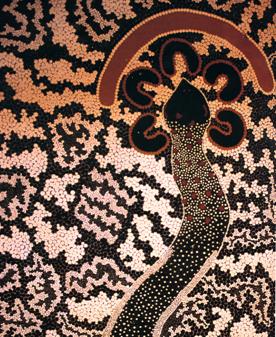
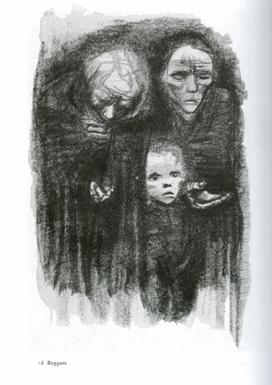
Fig. 41 (Australian aborigine)
Figl 42 (Kollwitz: The Beggars)
The argument between naturalistic and highly stylized painting exists
since the beginning of art, with the naturalistic cave paintings in
What does art say?
We are now, I hope,
agreed that the esthetic values of art are related to the skill with which it
transmits its message. Two portraits may depict the same person; two nativity
scenes show the same arrival of the magi, but the way in which this message is
delivered will determinate the value we give the work.
The beauty of a poem depends both on the depth of the idea that is expressed,
and the skill with which language is used. It is, in fact, rather difficult to
get enthusiastic about a poem that, using beautiful words, says ...nothing. Is
the same true of painting? Why should it not, like poetic language, transmit a
message external to the artistic value
There is a contemporary
school of thinking that proposes that the answer is no. For this line of
thought, the formal aspects, or even the activity itself rather than the
product, represent the artistic value. Applied art’ is somehow tainted by its
non-esthetic aspects, and inferior to ‘art pour l’art’. This viewpoint is alien
to me, and it is certainly anti-historical. We will never know why the artists
in prehistoric times painted the walls of their caves. Almost the entire artistic
production previous to the 20th century, however, was triggered by
sponsors who were interested in a religious scene, a portrait showing their
beauty or social standing, an erotic stimulant, often disguised as a scene of
classic mythology, a battle scene that would please their ruler. Even music,
which is by its nature more abstract than the visual acts, has its love songs
and operas. The main reason I object to the exclusively formal attitude is that
the rejection of the motive has often brought us meaningless triviality. I
cannot help to think that the work of an artist moved by social injustice (fig.
35) is more interesting than a canvas all painted in black, or the famous
urinal exhibited as an art object by Duchamp.
There is an important modern school of artists who produce paintings
without a recognizable external subject (figs. 37-40).Their way of managing
paint reveals their emotions, and if they are successful, they can transmit
them to the observer. In the representative mode of painting as well, much of
the painter’s emotive message may be related only indirectly to his ostensive
subject. But ultimately this is what counts.
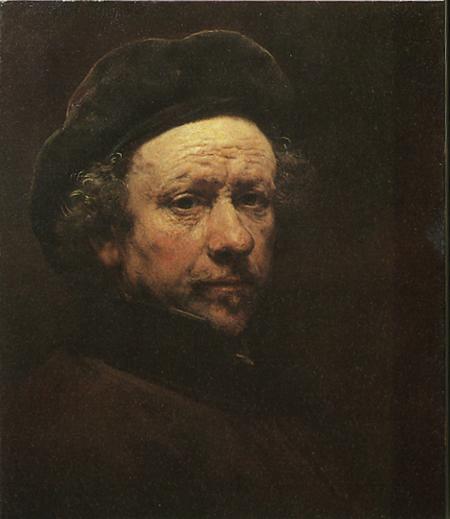
Fig.
43. (Rembrandt)
In the self-portrait, the artist reveals his feelings and moods in a way
that has more impact than any words he could have written. This skill of
transmitting to us emotions through space and time I believe to be the essence
of art.